Paid Traffic Landing Pages: How to Turn Ad Clicks Into Conversations That Convert
A paid landing page should continue the conversation started by the ad. Learn how to match the page's first answer to the visitor's decision-stage question.
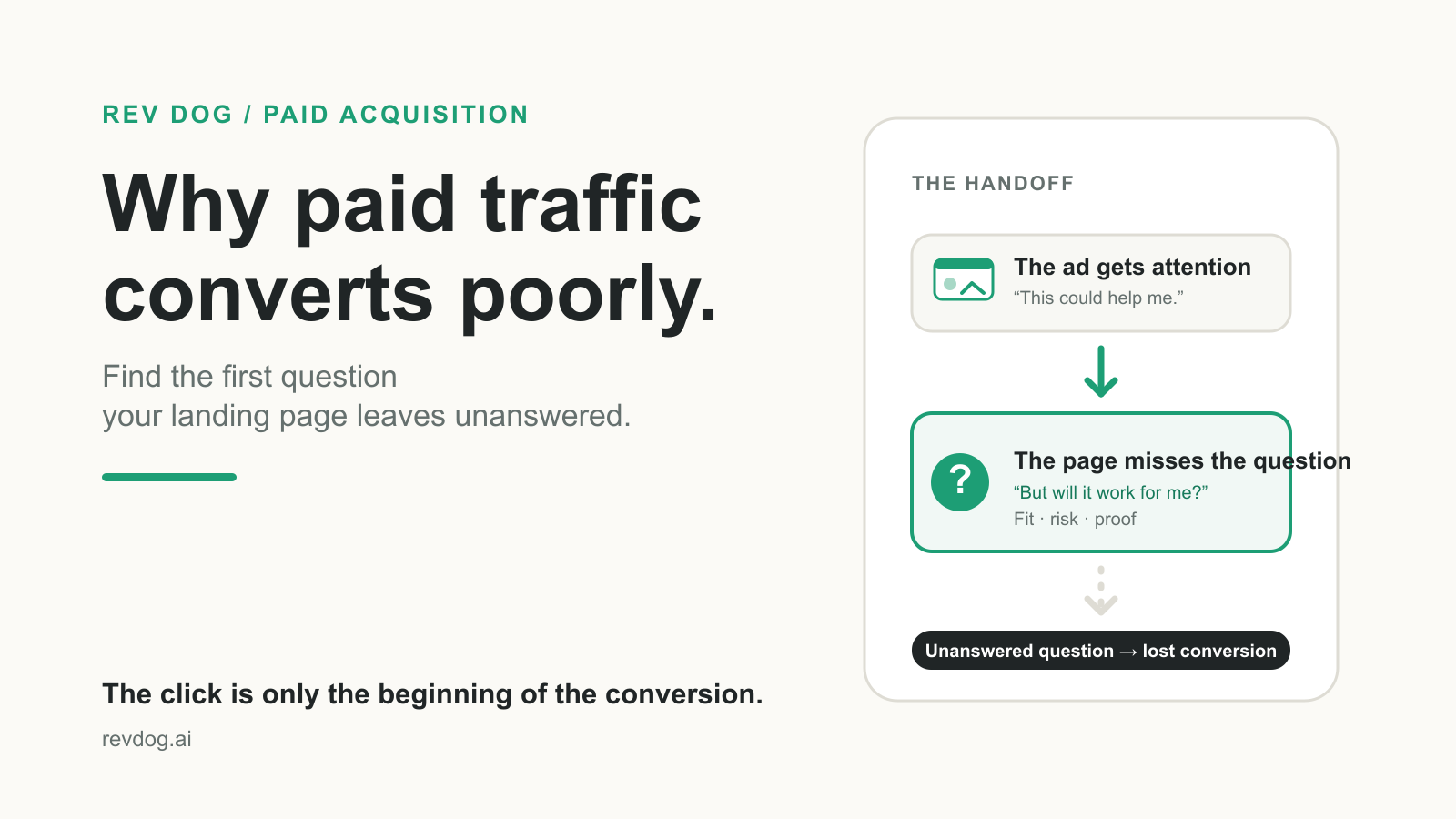
You can have a relevant keyword, a good ad, and a polished landing page—and still lose the visitor in the handoff between them.
That is the uncomfortable truth about many paid traffic landing pages. Teams optimize the ad account in one place and the page in another. The ad wins attention. The page starts a generic pitch. The visitor has to work out whether the offer applies to them.
Some will do that work. Most will not.
The job of a paid landing page is not simply to repeat the headline from the ad. It is to continue the conversation the ad began and answer the next question that visitor needs resolved.
Why generic landing pages waste paid traffic
Paid visitors are not a single audience. Even within one campaign, people click for different reasons.
Someone searching for “best [category] software” is checking whether a solution exists and whether you belong on their shortlist. Someone who clicks an “[category] alternative” ad is already comparing options and wants to understand the switching cost. Someone responding to a performance claim wants evidence before they give you their time.
If all three land on the same fixed page, they see the same order of proof, the same feature list, and the same call to action. That page may be accurate. It may even convert reasonably well on average. But it leaves revenue on the table because it treats different decision stages as the same visit.
This is why “the traffic is low intent” is often a misleading conclusion. The click can be relevant while the experience after the click is incomplete.
Start with the promise behind the click
Every paid landing page should begin with a simple question: what did we just promise this visitor?
The answer is rarely just the keyword. It is the claim, concern, or outcome that caused the person to click.
| What the ad signals | The visitor's likely next question | What the page should answer first |
|---|---|---|
| “Reduce manual reporting” | Will it work with our existing stack? | Integrations, workflow fit, and implementation detail |
| “[Competitor] alternative” | Is switching worth the disruption? | Migration path, differences, and proof from switchers |
| “Increase conversion rate” | Is the result credible for a business like mine? | Method, relevant evidence, and measurement approach |
| “Built for enterprise teams” | Will procurement or security block this? | Security, SSO, governance, and buyer-ready documentation |
The best first answer depends on the visitor. A fixed page can only make one guess. That is why matching the keyword in the H1 is a useful start, but not the whole job.
The three questions paid visitors need answered
Most paid-traffic conversion gaps are some combination of fit, risk, and proof.
1. Does this fit my situation?
Visitors want to know whether the product works for their team, use case, industry, workflow, or existing tools. Features alone do not answer this. Specific examples, integrations, and use-case language do.
2. What could go wrong if I choose this?
Risk is not always a pricing objection. It may be implementation time, migration, security review, support burden, or the chance that a result will not hold up. A visitor who cannot resolve the risk will often leave quietly rather than book a call.
3. Why should I believe the claim?
Paid ads make promises. The landing page earns trust in them. The relevant proof might be a customer outcome, a transparent method, a demo, a comparison, or a clear explanation of how the result is measured.
The page does not need to front-load every answer. It needs to make the most relevant one easy to find before the visitor loses momentum.
How to find the gaps in a paid landing page
Do not begin with a redesign. Start with evidence.
Read the search term and the ad together
Look at the actual query or audience, then the ad that was shown. What promise did the visitor see? What question would a rational buyer ask immediately after that promise?
Review what happens after the click
Look beyond the headline conversion rate. Check which pages paid visitors visit next, where they leave, and what they search for in navigation or documentation. If visitors repeatedly hunt for pricing, integrations, security, or comparisons, the landing page may be making an important answer hard to reach.
Listen to sales and on-page conversations
Sales calls, support tickets, demo notes, and on-page questions reveal the language buyers use when the page did not resolve something. The same question asked repeatedly is not just a sales objection. It is a page gap.
Separate volume from impact
The most frequently asked question is not always the one costing the most conversions. A question about a free trial may come up often but be easy to resolve. A question about CRM compatibility may be asked less often yet block a higher-value segment entirely.
Prioritize by the revenue at risk, not only the count of questions.
Improve the answer without rebuilding everything
Once you identify a likely gap, test a focused answer before rewriting the whole page.
For example, add a prominent integration proof point for visitors arriving from a workflow-specific ad. Add a comparison or migration explanation for competitor terms. Add a short explanation of the measurement method for a performance claim.
The goal is not more copy. It is less uncertainty at the moment a buyer needs to decide whether to continue.
This can be especially effective when the page can adapt to the context of the click. An ad can tell you the promise that earned attention. A visitor's question tells you what proof or answer has to come next.
Measure incremental lift, not just attributed conversion
It is easy to convince yourself a new paid landing page experience worked. A visitor may engage with a new element, convert later, and receive a tidy attribution path in analytics. That does not automatically mean the element created an additional conversion.
To know whether the change caused lift, compare it with a control group. Keep a portion of comparable traffic on the original experience and compare the conversion rate with visitors who saw the new answer. The difference is a better measure of what the change actually added.
This protects you from optimizing toward a flattering story in the dashboard. It also gives you confidence to scale a change that genuinely helps buyers convert.
Turn paid clicks into useful conversations
RevDog turns paid-ad context into a conversation on your landing page. It greets the visitor with the promise from the ad they clicked, answers the next question using content you approve, and shows you which gaps are costing conversions. Its built-in holdout compares visitors who see RevDog with those who do not—so you can measure proven incremental lift, not just attribution.