RevDog vs Piper: Website Sales Companion or Inbound AI SDR?
Piper works inbound leads across website and email. RevDog stays on-site to answer, qualify, convert, and turn buyer conversations into prioritized insight. Compare scope and fit.
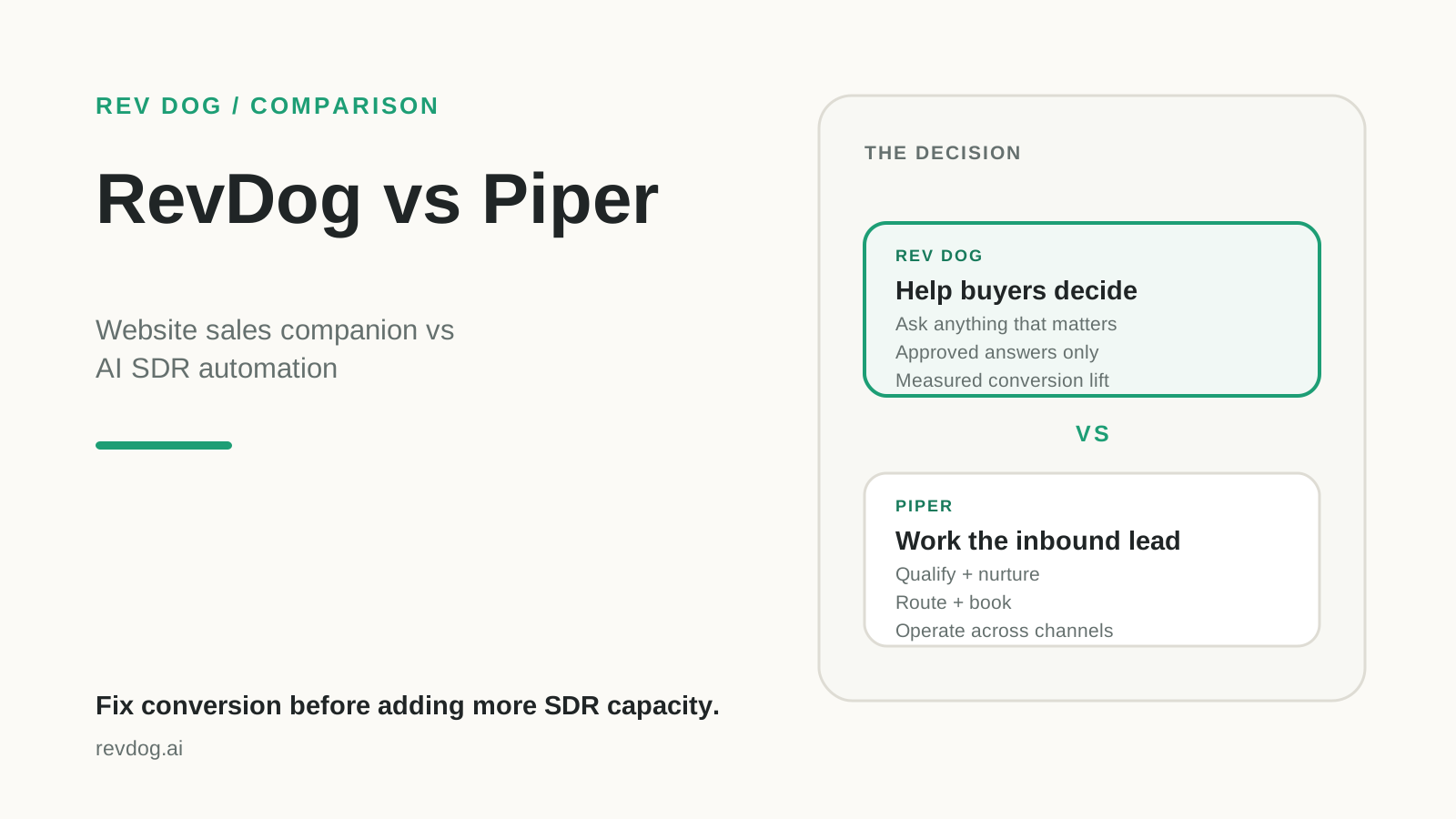
Seeing two AI agents on a B2B website can make Piper and RevDog look interchangeable. One is expected to operate a cross-channel inbound SDR workflow; the other owns the website sales conversation and the insight it produces.
Piper is Qualified's inbound AI SDR Agent. It works leads, qualifies buyers, nurtures them across the website and email, presents offers, and generates pipeline. RevDog is a sitewide sales companion. It answers from approved knowledge, qualifies visitors, handles objections, captures consented leads, offers booking or other approved conversion actions, reveals what blocks buying, and measures incremental lift against a holdout.
If your team is comparing the two, the decisive question is whether you want an autonomous digital SDR across channels or a governed sales companion for the website.
This article compares the two buyer-facing agents. If your evaluation includes Qualified's broader data, routing, reporting, and enterprise platform, read RevDog vs Qualified instead.
RevDog vs Piper at a glance
| Dimension | RevDog | Piper by Qualified |
|---|---|---|
| Intended buyer | B2B teams that want a website sales companion, buyer insight, and causal conversion measurement | B2B teams seeking an autonomous inbound AI SDR |
| Traffic source | Any website traffic; page, path, conversation, ad, query, and UTM context when available | Inbound website and email leads enriched with CRM, account, intent, and GTM data |
| Interaction model | Sitewide companion that answers, qualifies, handles objections, captures consented leads, and offers approved conversion actions | AI SDR that converses, qualifies, nurtures, serves offers, routes, and books meetings across channels |
| Grounding | Approved sources with citations; unsupported material questions are withheld and logged | Qualified content and GTM context, configured through Agent Studio goals, guardrails, evaluation, and feedback |
| Measurement method | Persistent randomized holdout measuring qualified-conversion lift | Qualified and Salesforce reporting |
| Pricing basis | Small base plus 20% of proven incremental lift, capped | Included in custom-priced Qualified Agentic Marketing Platform plans |
| When RevDog is not right | When the job requires autonomous SDR coverage across website and email, voice/video, nurture, complex routing, or GTM workflow execution | Those are core Piper responsibilities |
Measurement note: Qualified's public pages describe platform and Salesforce reporting, but the materials reviewed here do not document a persistent randomized visitor holdout equivalent to RevDog's. Confirm any incrementality requirement directly with Qualified.
What is Piper?
Piper is the AI SDR Agent inside Qualified's Agentic Marketing Platform. Qualified positions it as an always-on agent that works inbound buyers across the website and email.
Piper's public capabilities include:
- holding real-time website conversations through text, voice, and video;
- following up with and nurturing inbound leads over email;
- qualifying buyers and scheduling meetings;
- presenting personalized content and offers;
- using CRM, account, intent, web, and email context;
- coordinating with teammates through Slack;
- working across top-of-funnel nurture, bottom-of-funnel conversion, and product-led growth use cases.
This scope is why “AI SDR” is the useful category label. Piper is meant to do more than answer a question on a page. It is meant to decide how to work an inbound lead and take actions that move the lead toward pipeline.
What is RevDog?
RevDog is an on-page sales companion for B2B websites.
RevDog turns fixed sales pages into an interface where buyers can ask anything that matters to their decision. Rather than leaving a general-purpose LLM as the only place where buyers ask questions and form an opinion, your own grounded LLM answers from approved product and service knowledge and guides the buyer toward conversion.
It reads the current page and browsing journey, remembers what the buyer has revealed, and uses ad or search context when available. It answers from approved content, qualifies the buyer, captures contact details with consent, and guides the visitor toward a defined booking, trial, purchase, or other configured outcome.
The conversation has a second job: research. RevDog records the buyer's question, objection, comparison, qualification state, action, and missing proof. Learnings aggregates those signals into a ranked queue. Conversations lets the team replay each session and inspect the answer, source use, guardrails, state changes, and outcome.
RevDog does not call every downstream conversion a win. Eligible traffic is split between treatment and control. The system uses the difference in qualified conversion rates to estimate incremental lift and calculate any outcome fee.
Piper is an SDR; RevDog is a companion
This distinction prevents a misleading feature-by-feature comparison.
An SDR owns a pipeline-generation workflow. Piper can recognize and segment buyers, determine qualification, conduct conversations across channels, offer meetings, nurture leads, trigger workflows, and coordinate with the GTM stack. Its value proposition includes expanding inbound coverage and reducing the amount of lead work left to human SDRs.
A website sales companion owns the buyer's decision while they are on the site. RevDog helps the visitor resolve questions, qualify fit, and take the right approved action, while showing the team why similar visitors hesitate or leave.
Piper should be evaluated against inbound SDR capacity, speed-to-lead, meetings, pipeline, nurture, and GTM orchestration. RevDog should be evaluated against on-site qualification and conversion, buyer-question coverage, conversation intelligence, content learning, and measured incremental outcomes.
How their context differs
Piper's public materials emphasize rich GTM context. The Qualified platform can use lead and account records, Salesforce data, enrichment, segmentation, intent, buying stage, website activity, email engagement, qualification criteria, and routing rules. Piper uses that changing context to decide whom to engage and which action to take.
RevDog emphasizes page and decision context. It uses the current page, browsing path, session behavior, buyer's own words, and, when available, the ad or search message and UTM parameters. This lets the conversation remain relevant even when the visitor is not yet identified in the CRM.
For example, a buyer arriving from an alternative-comparison ad may first need migration proof. A buyer arriving from an ROI claim may first need the measurement method. RevDog uses that click-level context to begin with the likely next question, then lets the visitor correct or deepen the conversation.
Neither context model is universally better:
- Piper has the advantage when known-account, CRM, cross-channel, and routing context should shape the full inbound workflow.
- RevDog has the advantage when the anonymous buyer's live questions and on-site journey are the most useful signals available, with paid-click context adding another layer when present.
Website conversations and buyer actions
Piper is built to take a broad set of revenue actions. According to Qualified's official pages, Piper can answer questions, qualify visitors, serve offers, book meetings, route buyers, follow up by email, nurture leads, facilitate trials, and surface product-qualified leads.
RevDog uses a customer-configured action set across the site. It answers the buying question, qualifies the visitor, can capture a consented lead, and guides toward an approved terminal event such as a qualified demo, trial signup, or purchase. The aim is guidance, not manufactured urgency or a forced meeting in every conversation.
This makes Piper more suitable when the AI agent should actively operate the inbound motion. It makes RevDog more suitable when the team wants a controlled answer layer whose job is to help the buyer decide and show whether that help changed the outcome.
Grounding, guardrails, and review
Qualified's platform includes Agent Studio for onboarding, content, goals, guardrails, evaluation, and coaching. Qualified also says teams can track Piper's responses, see where information came from, and provide feedback.
RevDog uses an approved-content boundary. Answers link to their sources. If the source library does not support a material claim with sufficient confidence, RevDog withholds it and records the unresolved question. That question becomes a concrete content gap for the business to address.
Any buyer evaluating a customer-facing AI agent should test governance with real failure cases:
- Ask about a feature that does not exist.
- Ask for a price or contractual promise the source material does not authorize.
- Introduce stale or conflicting content.
- Test a comparison that invites an unsupported competitor claim.
- Inspect the source, audit trail, escalation, and correction workflow.
The useful distinction is not whether a vendor says “guardrails.” It is what the agent does when the approved answer is incomplete, uncertain, or commercially sensitive.
What customers report in practice
Piper is reviewed as part of the wider Qualified platform, so the available evidence covers both the agent and the operating system around it. Many comments appear in positive reviews and should be read as implementation risks, not universal failures.
Recent G2 and TrustRadius reviewers value the breadth of inbound coverage and the connection to Salesforce. They also report recurring friction around:
- monitoring AI answers for errors, unusual wording, or stale source material;
- complex segmentation, routing, scheduling, and CRM-field behavior;
- paid-attribution context being lost as a visitor moves through the site;
- limited flexibility for testing offers, chatbot creative, and CTA language;
- the time required to learn, configure, and maintain the platform.
A Piper trial should therefore test the full lead journey, not only a polished first conversation. Move between pages, change qualification details, reschedule, trigger alternate routing paths, introduce stale content, and inspect the resulting reporting.
RevDog is earlier and does not have Qualified's volume of independent reviews. Its answer governance, qualification, booking path, consent flow, insights, and lift measurement should be proven with the buyer's own traffic before purchase.
Measurement: pipeline attribution versus incremental lift
Qualified's current pricing page says all plans include Qualified Reporting and Analytics and Salesforce Reporting and Analytics. Qualified also publishes customer-reported outcomes for meetings, opportunities, revenue, and SDR efficiency.
RevDog focuses on the harder causal question: how many additional qualified outcomes occurred because eligible visitors received the companion experience?
To estimate that, RevDog keeps a randomized control group. Treatment and control run during the same period, and the commercial event is agreed before the test. The outcome fee is based on the supported gap between the groups. If no lift is established, the outcome fee is zero.
The public Qualified pages reviewed for this article do not describe a persistent randomized visitor holdout equivalent to RevDog's. That does not establish that Qualified cannot support one. If incrementality is important, ask Qualified how it separates influenced or attributed pipeline from conversions that would have happened without Piper.
Pricing and packaging
Qualified's public pricing page packages Piper within Premier, Enterprise, and Ultimate platform plans. Prices are not published; buyers request a customized plan. All tiers include core agent and platform capabilities, while higher tiers add enterprise APIs, policies, multiple sites or brands, multiple agent profiles, production instances, and high-volume support.
RevDog uses a small base fee plus 20% of proven incremental lift, with an agreed cap. The performance component applies to a qualified outcome rather than chats, button clicks, or every conversion touched by the product.
This makes the buying logic different:
- Buy Piper when the expected value of autonomous inbound coverage, meetings, nurture, and pipeline orchestration justifies the platform quote.
- Buy RevDog when you want a focused website sales companion whose variable fee depends on measured incremental outcomes.
Piper fits when
Piper is likely the stronger choice when:
- Your primary requirement is an autonomous inbound AI SDR.
- You want one agent to work website and email conversations around the clock.
- You need qualification, meeting booking, lead nurturing, offers, routing, and workflow actions.
- CRM, account, intent, and cross-channel context should drive every engagement.
- Voice, video, multilingual conversations, or agentic PLG are important.
- Expanding coverage or reducing repetitive SDR work is central to the business case.
- You need the larger Qualified platform around the agent.
When RevDog is preferable
RevDog is the stronger choice when the constraint is conversion rather than inbound SDR capacity:
- You are spending heavily on traffic but qualified conversion does not justify the acquisition cost.
- You want more conversions from the current ad budget before buying more clicks.
- You cannot see the buyer questions, objections, and missing proof behind weak conversion.
- Website visitors leave with unanswered sales questions or unresolved objections.
- You want to qualify visitors, capture consented leads, and present the right approved action on-site.
- Page, journey, and, when available, ad or search context should shape the next answer.
- Anonymous conversational intent matters before account identity is available.
- You want to discover and rank the questions behind lost conversions.
- You want unsupported answers withheld and turned into a content-improvement queue.
- A persistent randomized holdout is required to prove incremental conversion lift.
- You want aggregate Learnings and inspectable Conversations alongside a focused companion, rather than an autonomous SDR operating across channels.
Can RevDog replace Piper?
For the website buying journey, yes, and RevDog may be the better fit. Buyers increasingly research through search, ChatGPT, and other LLMs. A fixed landing page cannot respond to the specific questions shaping their opinion, so buyers either leave those questions unanswered or return to an external system for the answer.
RevDog gives buyers an interface on your own site to ask anything that matters to their decision. It answers from approved knowledge, qualifies and guides the buyer, captures a lead with consent, and offers the right conversion action. When it cannot support an answer, it does not bluff. It records the gap so the team can answer it and improve the knowledge available to future buyers.
Piper is the broader choice when the job includes email nurture, voice or video, enterprise routing, and autonomous SDR workflows across channels. RevDog does not need to reproduce those functions to be the stronger product for diagnosing and improving website conversion.
Can Piper replace RevDog?
Piper can engage, answer, qualify, and convert website visitors, so there is meaningful overlap. It may be the more complete choice for an organization already buying Qualified as its inbound platform.
Before treating it as equivalent, verify four RevDog-specific requirements: grounding answers in approved cited content, inspecting individual conversations, producing a prioritized buyer-question and content-gap loop, and measuring the result with a persistent randomized holdout tied to the commercial model.
Final verdict
This decision turns on the role you are hiring the software to perform.
Choose Piper to automate a broad inbound SDR role across channels. Choose RevDog to convert more of the traffic you already have, learn why buyers hesitate, and make the website respond to each buyer's decision.
Write that brief first. If it centers on nurture, routing, and email follow-up, evaluate Piper. If it starts with expensive traffic, weak conversion, and no clear explanation for why buyers leave, evaluate RevDog.
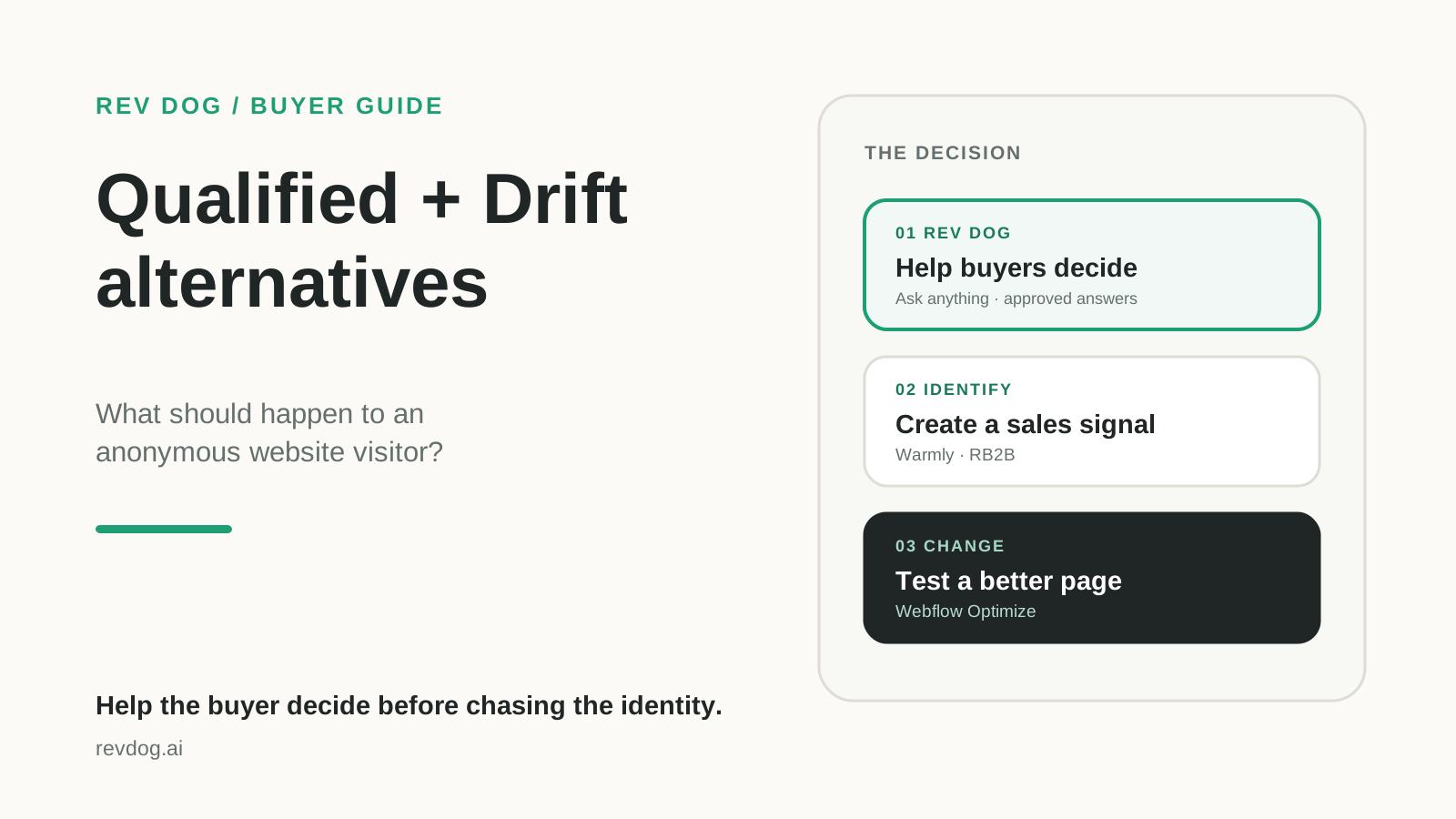
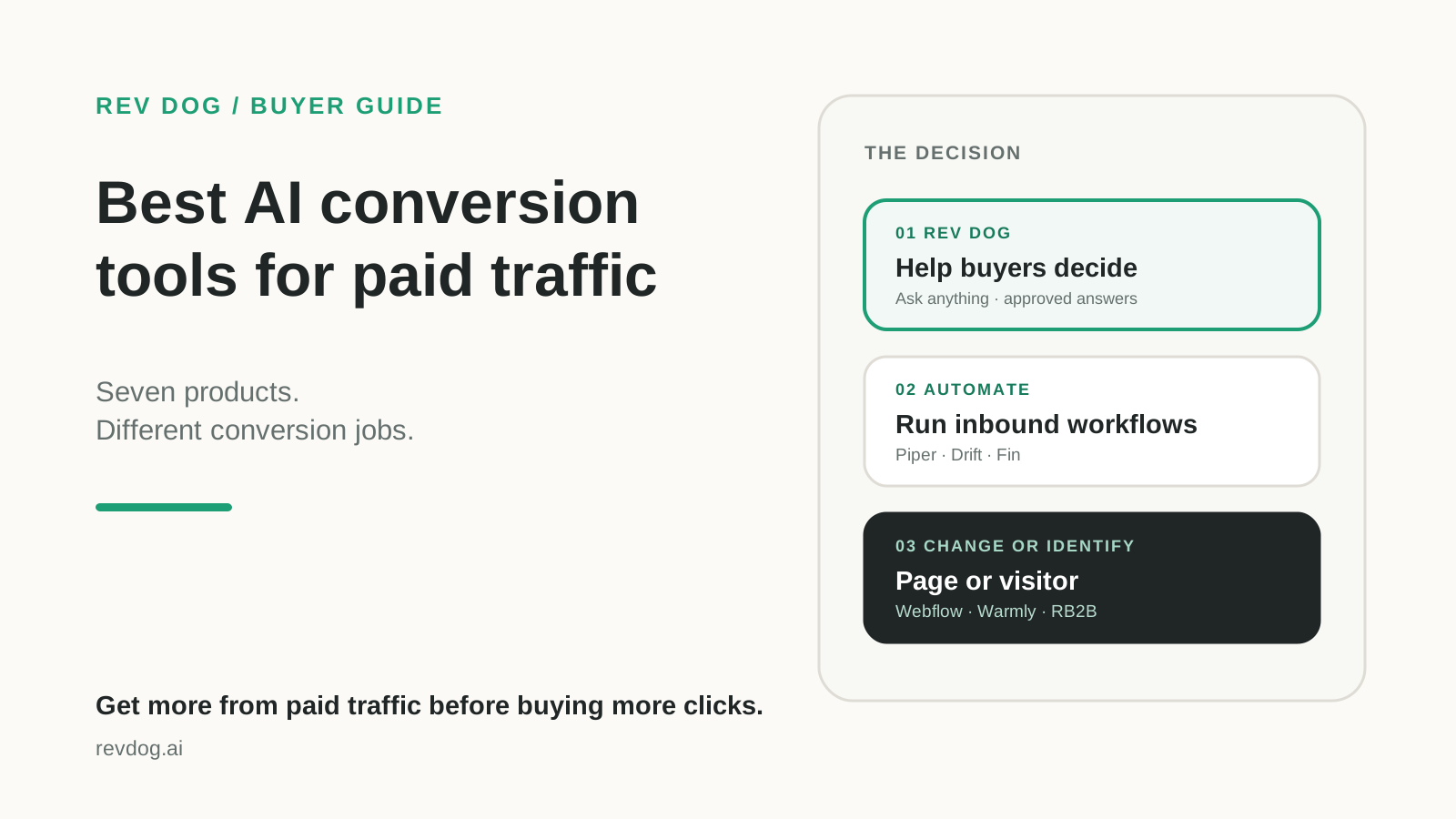
For the wider selection, see best AI conversion tools for paid-traffic landing pages and best Qualified and Drift alternatives for anonymous visitors.
Sources and review date
Piper facts were checked against Qualified's official Piper, platform, pricing, AI SDR playbook, and product-led growth pages on August 17, 2026. Customer-review patterns for the wider Qualified platform were checked against G2 and TrustRadius on July 30, 2026. RevDog capabilities and positioning were reviewed against the current RevDog website and product implementation on August 19, 2026. Product capabilities and packaging can change; verify requirements with each vendor before purchasing.