RevDog vs Qualified: Which Website Conversion Platform Fits Your GTM Motion?
Qualified operates a broad inbound AI SDR platform. RevDog is a sitewide sales companion that answers, qualifies, converts, and reveals why buyers hesitate. Compare the two operating models.
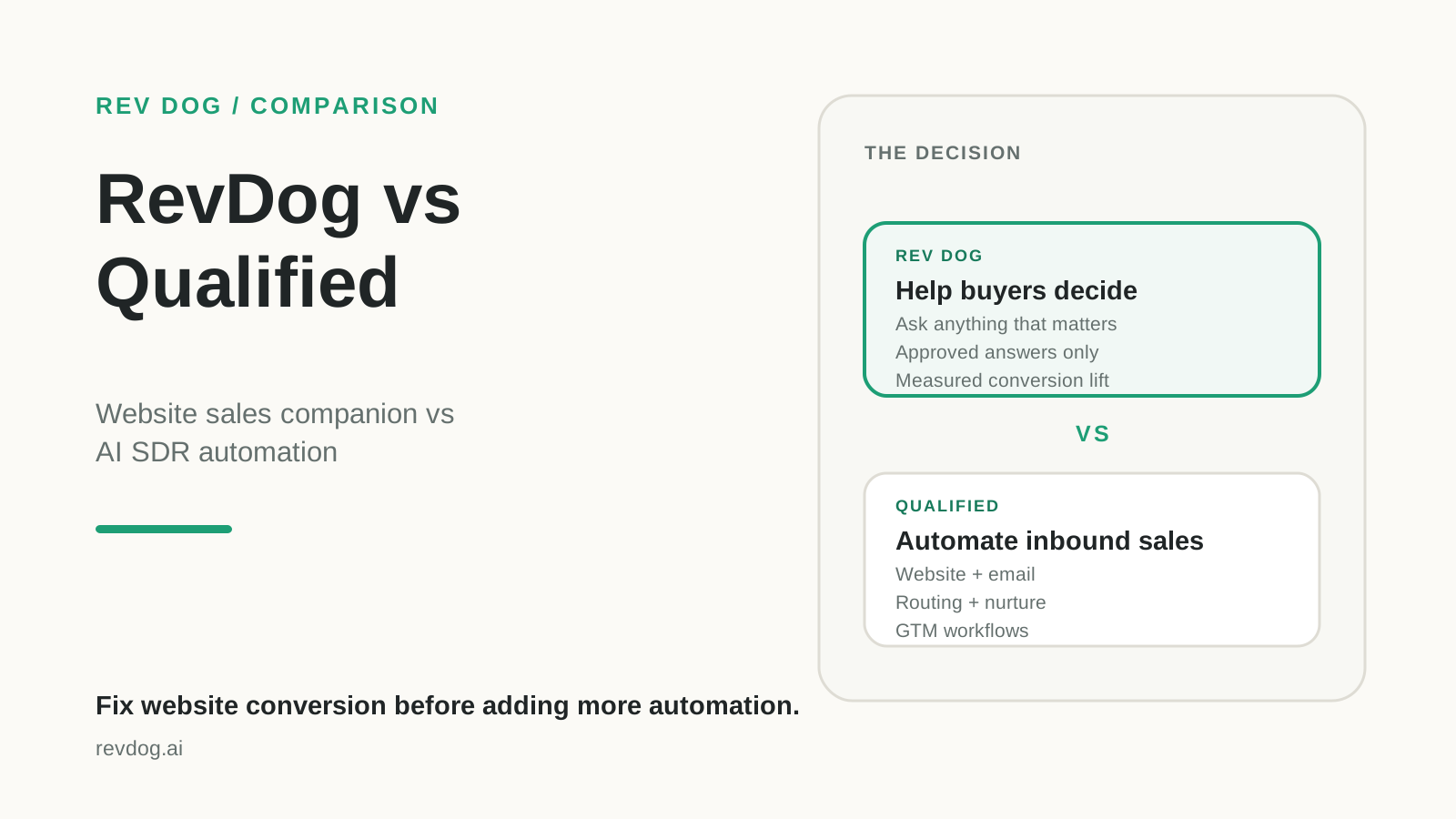
At first glance, Qualified and RevDog occupy the same space: both can talk with B2B website visitors, answer questions, and guide them toward a sales action. The overlap ends quickly once you ask what each product is expected to own.
Qualified is an agentic marketing platform built to work inbound demand across the website, email, and connected go-to-market systems. RevDog is a sitewide sales companion that answers buying questions, qualifies visitors, captures consented leads, and guides them to an approved action such as booking a demo, starting a trial, or purchasing.
The practical dividing line is the operating model, not whether the software works beyond an ad page. Qualified covers a broad inbound pipeline motion with deep CRM context, sophisticated routing, and an AI SDR operating across channels. RevDog stays with the buyer across the site, uses approved knowledge to move the live conversation forward, and turns those conversations into evidence about objections, qualification, content gaps, and incremental conversion. Ad-aware landing pages are the starting wedge, not the product boundary.
The urgency comes from a change in buyer behavior. Prospects increasingly research categories through search, ChatGPT, and other LLMs before and during a buying decision. If your website only presents a fixed narrative, those external systems may become the only place where buyers can ask the questions that shape their opinion of your product.
RevDog turns fixed sales pages into an interface where buyers can ask anything that matters to their decision. Rather than leaving a general-purpose LLM as the only place where buyers ask questions and form an opinion, your own grounded LLM answers from approved product and service knowledge and guides the buyer toward conversion. It withholds what it cannot support and surfaces the missing answer for the team to teach it.
This article compares RevDog with the full Qualified platform. If your evaluation is specifically about Qualified's AI SDR Agent, read RevDog vs Piper instead.
RevDog vs Qualified at a glance
| Dimension | RevDog | Qualified |
|---|---|---|
| Intended buyer | B2B teams that want a governed website sales companion plus direct buyer insight and causal conversion measurement | B2B marketing organizations seeking an AI SDR and broader inbound pipeline system |
| Traffic source | Any website traffic; ad, query, UTM, page path, and session behavior add context when available | Website and email demand connected to CRM, account, intent, and GTM-system data |
| Interaction model | Sitewide companion that answers, qualifies, handles objections, captures consented leads, and offers approved booking, trial, or purchase actions | Piper engages, qualifies, routes, presents offers, nurtures, and books meetings across channels |
| Grounding | Approved sources with citations; unsupported material questions are withheld and recorded as content gaps | Agent Studio content, business context, goals, guardrails, evaluation, coaching, and response-source review |
| Measurement method | Persistent randomized holdout and treatment-versus-control qualified-conversion lift | Qualified and Salesforce reporting and analytics |
| Pricing basis | Small base fee plus 20% of proven incremental lift, subject to a cap | Custom quote across Premier, Enterprise, and Ultimate plans |
| When RevDog is not right | When you need a full AI SDR, cross-channel nurture, complex routing, voice/video, multiple brands, or enterprise GTM orchestration | Those requirements fit Qualified's wider scope |
This table describes public positioning and product scope as of August 17, 2026. It is not a claim that either platform cannot support a use case outside its primary focus.
Measurement note: The Qualified pages reviewed for this comparison describe Qualified and Salesforce reporting, but do not document a persistent randomized visitor holdout equivalent to RevDog's. This does not mean Qualified cannot support one.
What is Qualified?
Qualified describes itself as the Agentic Marketing Platform powering Piper, its AI SDR Agent. The platform brings together buyer and account context, agent onboarding, goals and guardrails, actions, and ongoing optimization.
Its scope is broad. Piper can engage buyers on the website using text, voice, or video; work inbound leads over email; schedule sales meetings; present personalized offers; and collaborate with teams in Slack. Qualified also emphasizes enrichment, segmentation, advanced routing, automated workflows, Salesforce reporting, and integrations with more than 20 go-to-market systems.
That makes Qualified more than a website chat product. It can serve as infrastructure for an inbound pipeline motion.
Qualified's current public pricing page lists Premier, Enterprise, and Ultimate plans without publishing dollar prices. Enterprise adds capabilities such as enterprise APIs, custom cookie and data-retention policies, Salesforce sandbox support, and multiple websites and brands. Ultimate adds multiple agent profiles, multiple production instances, and support for high-volume websites and contact databases.
What is RevDog?
RevDog is a sales companion for the website. Paid campaigns provide a useful first deployment because their promise, audience, and cost make the conversion problem easy to define, but RevDog can answer sales questions on any installed page.
It uses the page, browsing path, conversation, and, when available, ad or search context to understand the visitor's decision. It answers from content the business has approved, qualifies without forcing every buyer through the same script, captures contact details with consent, and guides the visitor toward a defined action such as booking a demo, starting a trial, or purchasing.
The product then turns those conversations into a ranked list of conversion fixes. Learnings shows recurring objections, topics, incumbent comparisons, voice-of-customer themes, qualification coverage, answer quality, action mix, and outcomes. Conversations provides the session-level replay: what the buyer asked, what RevDog answered, which sources and guardrails shaped the response, how qualification changed, and why the next action was chosen.
RevDog's measurement model is also part of the product. A persistent randomized holdout keeps some eligible visitors in a control group. The system compares qualified outcomes for visitors who could use RevDog with outcomes for visitors who could not. Its outcome fee is based on the statistically supported treatment-control gap, not every conversion that happened after a conversation.
The biggest difference: operating the funnel versus testing the intervention
Qualified operates a substantial part of the inbound funnel. It combines an AI SDR with the data, rules, integrations, and actions required to recognize buyers, nurture them, qualify them, schedule meetings, and coordinate with revenue teams.
RevDog concentrates on the website conversation rather than the entire cross-channel SDR workflow. Its core question is not simply, “Did the companion influence pipeline?” It is, “Did more qualified conversions happen because the companion was present?”
Those are different operating models.
If your main problem is that inbound leads are not being worked quickly or consistently across the website and inbox, Qualified's larger scope is likely an advantage. If your main problem is that website buyers leave with unanswered questions, your team cannot see the objections behind lost demand, or conversational conversions cannot be tied to demonstrably incremental outcomes, RevDog may be the better fit.
Context and personalization
Qualified's strongest context comes from the go-to-market system around the buyer. Its public materials emphasize Salesforce data, account segmentation, intent signals, website activity, email engagement, enrichment, qualification criteria, and routing rules. That context helps Piper decide who to engage and what action to take.
RevDog emphasizes first-party decision context: the current page, browsing path, questions asked, qualification state, and, when available, the ad, search query, and campaign parameters that produced the visit. This is useful when a visitor is anonymous but has revealed meaningful intent through behavior and conversation.
The distinction is not “personalized versus generic.” Both products personalize. The distinction is which context anchors the experience:
- Qualified is strongest when CRM, account, intent, and cross-channel context should drive the next action.
- RevDog is strongest when page context and first-party conversational intent should drive the next answer, with acquisition context improving relevance when it exists.
Content control and answer governance
Qualified's Agent Studio supports onboarding, training content, goals, guardrails, evaluation, coaching, and feedback. Its platform page says teams can see where Piper pulls information and adjust responses to keep messaging accurate.
RevDog answers from approved sources and links answers back to those sources. When the available evidence cannot support an answer with sufficient confidence, RevDog withholds the claim and records the question as a content gap. That gives the marketing team a concrete queue of missing proof, comparison content, and decision-stage answers to create.
Both approaches recognize that a revenue-facing agent needs governance. Buyers should evaluate the exact review, escalation, audit, and approval workflows they require rather than relying on the presence of an “AI guardrails” label.
What customers report in practice
Customer reviews add useful context to Qualified's broad product brief. The limitations below often appear inside otherwise positive reviews, so they should be treated as evaluation points rather than proof that the platform does not work.
Reviewers commonly value Qualified's ability to engage inbound buyers, connect website activity with Salesforce, and expand coverage beyond what a human team can handle. Recurring friction in recent G2 and TrustRadius reviews includes:
- AI answers that still need supervision, including odd responses or answers drawn from stale content;
- UTM or paid-page attribution becoming inconsistent after a visitor navigates before chatting;
- routing, scheduling, CRM-field, and rescheduling edge cases;
- demand for more flexible A/B testing and consolidated reporting;
- a learning curve around segmentation, experiences, and ongoing administration.
These reports do not erase Qualified's breadth. They identify what to test: use stale and conflicting content, follow a visitor across pages, exercise routing and calendar edge cases, and ask how experiments separate influenced pipeline from incremental outcomes.
RevDog has not yet accumulated a comparable independent review corpus. Buyers should validate its grounding, lead capture, conversion actions, integrations, conversation insights, and holdout design in a live pilot rather than treating product specifications as customer proof.
Measurement and reporting
Qualified includes Qualified Reporting and Analytics as well as Salesforce Reporting and Analytics in all publicly listed plans. Its website also presents customer-reported results such as more meetings, opportunities, pipeline, or SDR efficiency.
Those outcomes may be useful evidence, but attribution and incrementality are not the same thing. A platform can participate in a conversion without establishing whether that conversion would have occurred anyway.
RevDog treats that distinction as a product requirement. Its holdout is intended to estimate the counterfactual: the conversion rate without RevDog during the same period. The outcome fee remains zero when the experiment does not establish incremental lift.
Qualified may offer experimentation or measurement capabilities beyond what is described on the public pages reviewed for this comparison. If causal measurement is a purchase requirement, ask both vendors directly:
- Is assignment randomized at the eligible-visitor level?
- Does a persistent control group remain active after launch?
- Which qualified business outcome is evaluated?
- How are repeat visitors and cross-session conversions handled?
- Is statistical uncertainty visible?
- Is pricing based on attributed conversions or measured incremental lift?
Pricing model
Qualified uses custom pricing. Its public page describes three platform tiers and asks buyers to schedule a demo for a tailored plan. This structure is consistent with a broad platform whose cost depends on organizational scale, integrations, websites, data volume, and deployment requirements.
RevDog combines a small base fee with 20% of proven incremental lift, subject to an agreed cap. The measured event must be a qualified terminal outcome, such as a qualified demo, trial, or purchase. A chat start or vanity engagement event does not qualify.
The models create different procurement questions. With Qualified, evaluate the platform scope and expected pipeline capacity against the quoted cost. With RevDog, agree in advance on the outcome definition, experiment design, value per incremental outcome, fee cap, and conditions required for statistical confidence.
Choose Qualified when
Qualified is likely the stronger choice when:
- You want an AI SDR to work inbound leads across the website and email.
- CRM and account context should drive segmentation, qualification, routing, and offers.
- You need voice, video, multilingual engagement, Slack collaboration, or multi-stage nurture.
- You need a platform for multiple brands, agent profiles, production instances, or very high volumes.
- Replacing or extending inbound SDR capacity is the primary business case.
- Your team is prepared to implement and operate a broader agentic marketing platform.
When RevDog is preferable
RevDog is the stronger choice when the business problem is conversion efficiency rather than SDR capacity:
- You spend heavily on acquisition but the resulting conversion rate does not justify the return.
- You need more qualified conversions without increasing the advertising budget.
- You know conversion is weak but analytics cannot explain the buyer questions and objections behind it.
- Website visitors leave with sales questions or objections that static pages do not resolve.
- You want the companion to qualify visitors, capture consented leads, and offer the right booking, trial, or purchase action.
- Different pages, ads, or searches bring buyers with different questions.
- You want useful first-party intent even when the visitor cannot be identified at the account level.
- You need a ranked view of objections, comparisons, and missing content behind lost conversions.
- Approved-source answers and explicit withholding are central to brand governance.
- You require a randomized holdout before calling conversions incremental or charging an outcome fee.
- You want per-conversation inspection and aggregate buyer insights without replacing the broader inbound SDR stack.
Can RevDog replace Qualified?
For the website-conversion job, yes, and it can be the preferable choice. A company does not need to buy a broad agentic marketing platform simply to get more value from traffic it already pays for.
RevDog answers the questions static pages leave unresolved, qualifies the visitor, guides them toward the right action, and shows the team why other buyers did not convert. It then tests whether that on-site buyer interface produced additional qualified outcomes, not merely whether it appeared somewhere in the attribution path.
Qualified remains the broader choice when the actual requirement includes cross-channel email nurture, enterprise routing, enrichment, voice or video, and autonomous SDR workflow orchestration. That is a different buying problem, not evidence that a broader platform is automatically better for website conversion.
Can Qualified replace RevDog?
Qualified can clearly engage and convert website visitors, including visitors arriving from marketing campaigns. But broad feature coverage does not automatically reproduce RevDog's approved-source discipline, buyer-question learning loop, per-conversation inspection, or treatment-control measurement.
The remaining question is measurement philosophy. If you need ad-message continuity, a content-gap learning loop, and outcome pricing settled against a persistent randomized holdout, confirm how those requirements would be implemented and reported in Qualified.
Final verdict
The deciding line is the growth constraint. Qualified can expand and orchestrate inbound SDR capacity. RevDog can increase the productivity of existing website traffic while revealing what buyers need before they convert.
Choose Qualified when the business case is cross-channel AI SDR capacity and GTM orchestration. Choose RevDog when the business case is more conversion from the traffic you already have, a website that answers each buyer's questions, and evidence of what actually improved.
Define that operating problem before comparing feature lists. It will eliminate most of the ambiguity in this decision.
For the full category, see best AI conversion tools for paid-traffic landing pages and best Qualified and Drift alternatives for anonymous visitors.
Sources and review date
Qualified product facts were checked against its official platform, Piper, pricing, and Salesforce pages on August 17, 2026. Customer-review patterns were checked against G2 and TrustRadius on July 30, 2026. RevDog capabilities and positioning were reviewed against the current RevDog website and product implementation on August 19, 2026. Product capabilities and packaging can change; verify requirements with each vendor before purchasing.